Retail property
Buying a shop that needs renovation: make the numbers work
The shop needs work. The numbers need more. A practical investor guide to retail renovation, occupier demand, total costs and a worked downside appraisal.
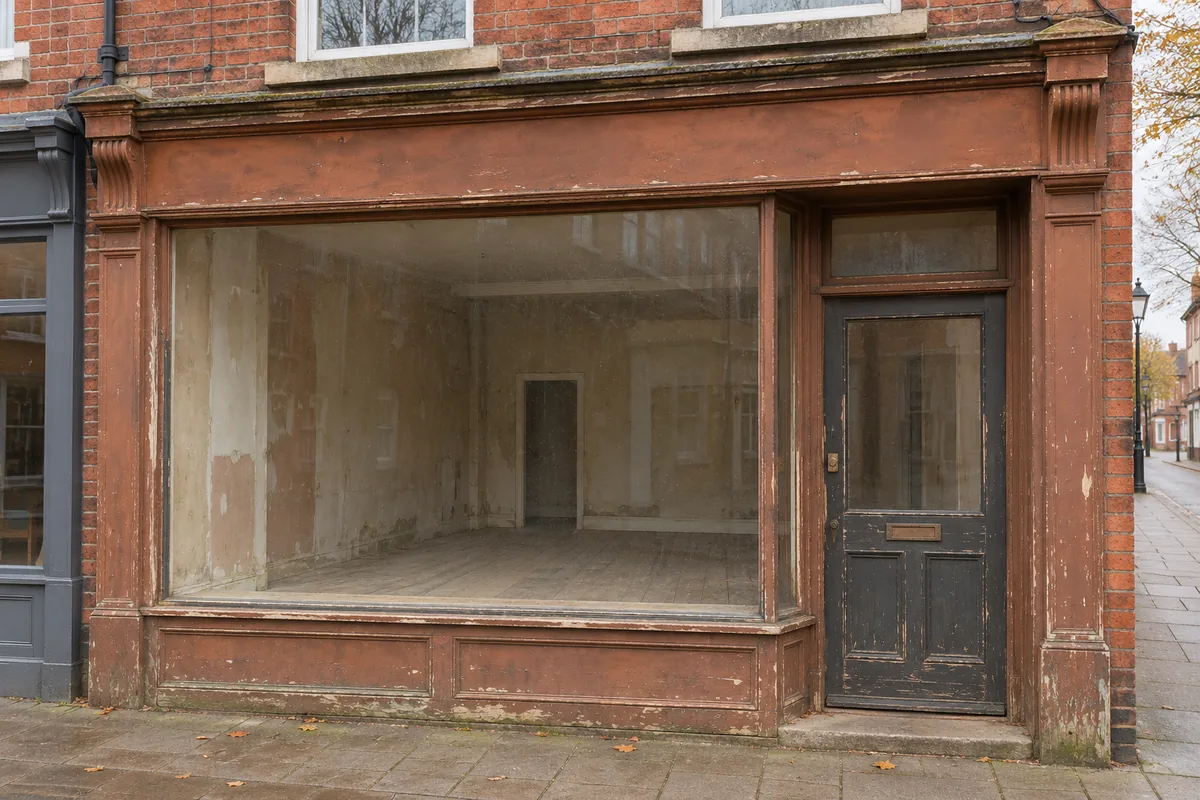
The shop needs work. The numbers need more.
Buying a shop that needs renovation can make sense when the location has credible occupier demand, the building can be made suitable at a realistic cost and the likely income or resale outcome justifies the total spend. Start with who would use it and what they would pay. Then investigate condition, permissions, energy performance and the cost of waiting for a tenant. A fresh frontage helps a shop look ready; it cannot create a customer base or turn rent into profit.
This guide is for investors considering retail property in the East Midlands or Peterborough, with purchase prices strictly below £2 million. It is about assessing an opportunity before buying, not assuming every empty shop is a bargain. The illustration is fictional, and the appraisal below uses invented figures rather than a local valuation or an available deal.
Find the occupier before choosing the paint
Picture two or three plausible occupiers for the actual unit: a retailer, a service business or another operator whose activity could fit, subject to permissions. Ask what customers would travel there for, how frequently they would visit and what they need from the street. Convenience shopping, appointment-based services and browsing businesses can need quite different locations.
Visit at several times. Note pedestrian movement, parking turnover, loading arrangements and the mix of occupied units nearby. A busy pavement outside a school at three may be quiet during the proposed tenant's trading hours. Speak to commercial agents about recent enquiries and completed lettings for comparable shops. Ask which types of business have shown interest, what stopped previous negotiations and how long similar units took to let.
Separate evidence from assumptions. A photograph of an occupied parade does not establish the rent for your shop. Ask for achieved terms where available, including incentives, lease length, condition and the date of agreement. An advertised rent is an opening position. Use a local commercial surveyor to interpret the evidence rather than transferring the highest asking rent on the street into your appraisal.
Can the frontage and layout do the job?
Look beyond the width of the display window. Can customers identify the entrance, see what the business offers and get inside comfortably? What is the usable trading area once you allow for circulation, storage, staff facilities and any treatment or preparation rooms? A long narrow unit can have a respectable total area while offering less useful space than a smaller, better shaped one.
Walk the servicing route. Check where deliveries stop, how goods reach storage, where waste is kept and whether collection conflicts with customers or neighbours. Ask your solicitor to verify the rights for rear access, shared passages, bins and parking. A door at the back is a physical feature; the right to use the route beyond it needs evidence.
Ask prospective occupiers or their advisers what specification they would need, without promising the premises will suit them. Power, ventilation, drainage, accessible facilities and security can change the scope substantially. Decide what a landlord should provide as a broadly usable shell and what an occupier would normally specify for its own business. Bespoke fit-out for an imaginary tenant is an expensive form of optimism.
Investigate condition before calling it cosmetic
Give the surveyor your intended works and likely occupier requirements. Discuss the roof, gutters, damp, structure, floors, drainage and services, plus the shopfront and any shared building elements. Ask which defects need further investigation before exchange and which costs could reasonably be planned later. A new ceiling may hide yesterday's leak without fixing tomorrow's.
If the title includes upper floors or the shop sits beneath another ownership, establish responsibility for the structure, roof and common parts. Check service charges, insurance arrangements and access for repairs with your solicitor. Do not assume that owning the shopfront means controlling everything above it.
Where planned work could disturb asbestos, obtain competent advice about the appropriate survey before intrusive work starts. HSE's asbestos survey guidance distinguishes a management survey from a refurbishment or demolition survey. Establish which areas have actually been inspected and what remains inaccessible. Price investigations and specialist work into the programme rather than relying on a contractor to “have a look once we start”.
Check the use and approvals for your proposed tenant
In England, shops and several other business activities can fall within Class E, but the proposed activity and the property's planning history still need checking. GOV.UK's planning guidance explains use classes and when permission may be required. Ask the local planning authority or a planning professional about the actual proposal, conditions, external changes and any relevant restrictions.
A shopfront replacement, signage, extraction or alterations to a listed building can need additional consideration. Separately, title restrictions, lease terms or third-party consents may limit what you can do. Have the solicitor check those documents. Building regulations approval is distinct from planning permission, so establish what the proposed work requires with building control and your professional team.
Upper floors are a separate investigation, not a bonus flat waiting to happen. Access, title, planning, structure, fire safety, services and the economics all need checking. Do not build an investment case on assumed residential conversion. Any mixed-use or residential element also needs separate pension-provider and professional assessment; this article does not establish pension eligibility.
Build energy performance into the works scope
Ask for the current EPC where required and have an appropriate assessor review the proposed works before ordering equipment. The cheapest lighting or heating choice on a quote may be a poor choice for the building's future use. Obtain advice on what improvements are necessary, achievable and sensible alongside the renovation.
As checked on 20 November 2026, government guidance for non-domestic private rented property sets out the minimum EPC E requirement for properties and tenancies within scope, unless a valid exemption is registered. Check the specific building and proposed letting rather than assuming every shop is treated identically. The guidance also explains that exemptions may not transfer to a new landlord.
Do not confuse a future policy proposal with a rule already in force. Ask your assessor and solicitor to confirm the current position for the transaction, and consider longer-term operating costs as well as minimum compliance. Include confirmed energy works in the contractor's scope so they are not discovered after the nice new floor goes down.
Get comparable quotes and a sequence you can fund
Write a scope before comparing contractors. Identify repairs, landlord improvements and any tenant-specific work separately. Ask each contractor to price the same items and state exclusions, provisional sums, lead times and assumptions about access. Confirm whether figures include VAT and obtain transaction-specific tax advice; recoverability should never be guessed.
Allow for investigation, approvals, procurement, work, testing and handover. Ask which tasks depend on an external decision and what happens if that decision takes longer. Our new unit versus refurbishment guide uses the same useful principle: compare the property when it is ready for its intended use, not merely when the sale completes.
Discuss a sensible contingency with the surveyor and contractor based on what is still unknown. Keep it separate from the reserve for vacancy. Spending the works contingency does not make the holding costs disappear. Before committing, identify the largest unresolved item and ask whether you can still afford the project if it lands at the expensive end.
A hypothetical shop appraisal, with the awkward bits included
Imagine a vacant shop bought for £180,000. Allow £45,000 for renovation, £9,000 for professional and transaction costs, £8,000 for works contingency and £8,000 for the initial vacancy and holding period. The total of these illustrative lines is £250,000. Applicable acquisition taxes, finance costs and any additional or irrecoverable VAT are excluded and must be added separately using advice and actual quotations.
Suppose the assumed annual rent after works is £18,000. That is 10% of the purchase price, but only 7.2% of the £250,000 subtotal, before the excluded costs. If annual owner-retained operating costs are assumed at £3,000, the remaining £15,000 represents 6% of that subtotal before borrowing, tax and further capital expenditure. These figures illustrate the method; they are not a forecast, a market rent or a promised return. Rent is the income line, not the profit line.
Now test a tougher outcome. If works rise by £12,000 beyond the amounts already allowed, and an additional vacancy period costs £6,000 beyond the initial holding allowance, the subtotal becomes £268,000 before the same excluded items. If achievable rent is £16,200 and the assumed annual owner costs remain £3,000, the £13,200 balance is about 4.9% of that subtotal before finance, tax and future capital spending. That may change the price you can justify, or end the enquiry entirely.
Plan for an empty shop and a credible exit
Check business rates with the billing council, including any relief, its remaining period and who will be liable. GOV.UK's empty-property rates guidance explains the general rules and exceptions. Do not assume renovation makes a shop rates-free or that buying restarts a relief period. Budget using the property's actual position.
Allow for insurance suitable for vacancy and works, utilities, security, inspections, maintenance and any estate or building charges. Obtain a realistic marketing allowance and discuss likely incentives and tenant fit-out time. If you are exploring a tenant commitment before buying, our pre-let process guide explains why interest, heads of terms and a binding agreement are different stages.
Choose a primary exit and test a fallback. For a letting, assess the tenant, lease and sustainable income with your advisers. For resale, ask who would buy the completed property and what comparable evidence supports the assumed price, allowing for sale costs and time. Refurbishment spending does not automatically produce an equal valuation uplift, and refinancing depends on valuation and lender terms.
Three questions before you offer
Should I renovate before finding a tenant?
Resolve essential condition and compliance questions early, but test occupier demand before committing to specialist fit-out. A usable shell may appeal to several businesses; a highly tailored layout may only suit one. Agree the boundary between landlord and tenant works clearly.
Does a low asking price make a vacant shop good value?
Only if the total project cost is justified by credible income or resale evidence. Investigate why it is empty, what prevents occupation and how long you can fund it without rent. A cheap shop can become an expensive waiting room.
What should I include in a search brief?
State the purchase ceiling, preferred towns, total project resources, acceptable works and intended exit. Explain whether you need existing income or can fund a vacancy and refurbishment. PropSelect sources commercial purchases strictly below £2 million across the East Midlands, Peterborough and the Golden Triangle, including Derby, Nottingham, Leicester and Northamptonshire. An engagement fee and a purchase fee calculated as a percentage of the purchase price are agreed in writing before instruction. We find property; qualified advisers assess the legal, survey, tax and finance details. Send us your commercial investment brief and tell us how much renovation, and how much waiting, the numbers can support.