Commercial investment
How to Invest in Commercial Property in the East Midlands: Sheds, Land and Corporate Pre-Lets
How to assess East Midlands industrial sheds, development land and corporate pre-lets, with worked investment examples and a high street coffee shop transformation.
By Ashley Banfield, property expert with over 25 years’ experience.
An industrial shed rarely wins a beauty contest. Fortunately, your tenant is usually more interested in whether the delivery lorry fits through the gate. An empty high street shop presents a different picture, but the investment question is similar: which business could use it, what would they pay, and what would it cost to make the premises suitable?
To invest in commercial property in the East Midlands, start with occupier demand, calculate the full cost of acquisition and delivery, investigate the property and lease, and choose an exit your finances can support. The main routes include buying an occupied industrial unit, improving a vacant shed, or securing development land for a business with an agreed requirement.
A corporate pre-let can make future occupation more certain and support funding discussions. It does not automatically create a profitable development. This guide connects the location, occupier and appraisal decisions, including how the same principles can apply to a high street coffee shop.
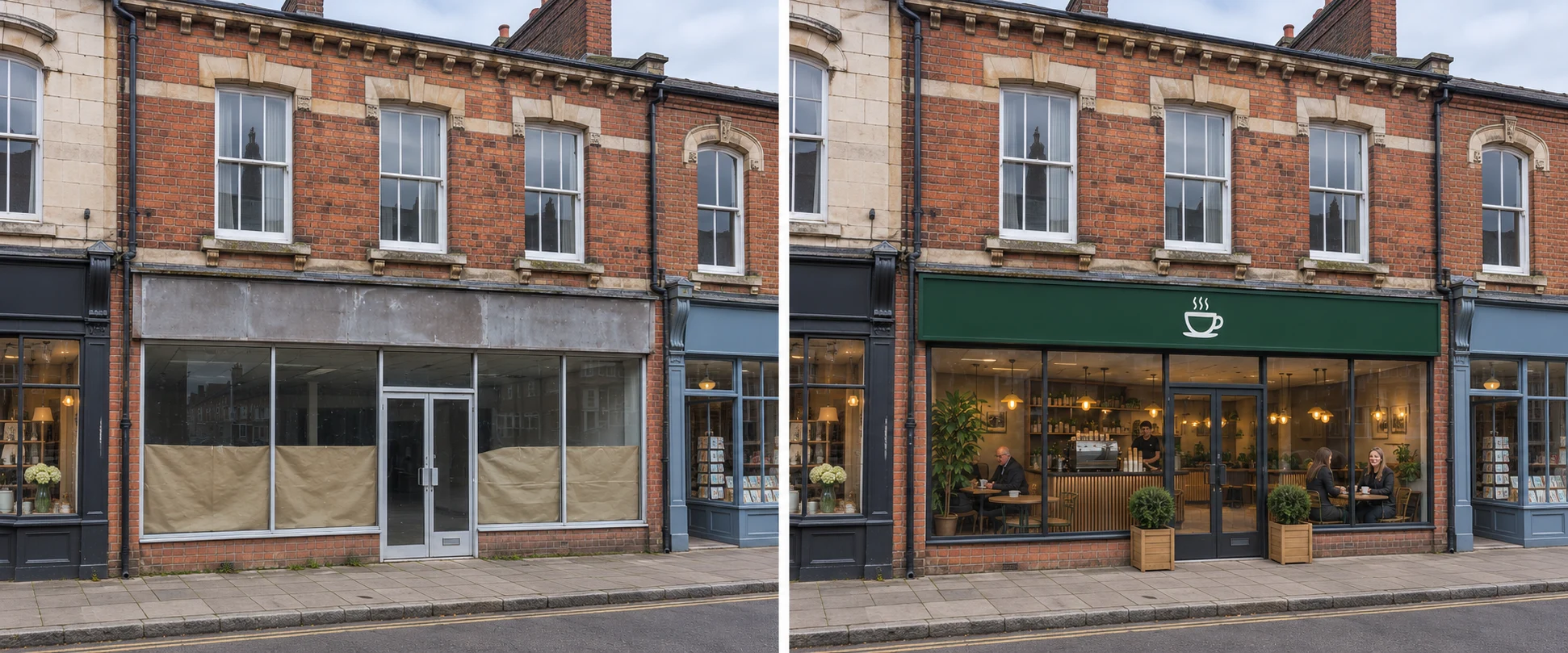
The banner illustrates a hypothetical vacant shop becoming a coffee shop. It is not an actual chain takeover, a property listing or a completed PropSelect transaction.
Why investigate commercial property in the East Midlands?
Savills reported 5.8 million sq ft of East Midlands logistics take-up in the first half of 2026, representing 38% of national activity in its market coverage. It also recorded more than 1.06 million sq ft of build-to-suit activity, where premises are developed around an occupier’s requirements. See Savills’ East Midlands logistics research.
Those figures provide regional context, not a rent forecast for a small workshop. Large distribution buildings and modest industrial units serve different businesses. A 2,000 sq ft unit can depend on local trades and suppliers rather than national logistics demand. Ask agents for completed comparable lettings, achieved rents, incentives and letting times, rather than relying on advertised rents.
Choose the route that fits your resources
Buying an occupied industrial unit may provide rent from completion, subject to the tenant paying. Your focus is the purchase price, building condition, tenant strength and lease. Check when a tenant can leave and which costs remain with the owner. A headline lease length is less useful without its break clauses.
Buying a vacant shed to refurbish offers a different opportunity. Better accommodation may attract a tenant and support value, but works, finance and holding costs arrive before rent. Buying development land adds planning, infrastructure and construction exposure. It usually needs deeper reserves and a more experienced professional team.
Decide what you can afford if occupation starts six months later than expected. An investment that works only when every date is met deserves another look. Cash reserves need to cover the difficult period, not just the purchase deposit.
Where should you look?
- Derby and surrounding estates: investigate engineering, manufacturing and supplier demand, with particular attention to power, workforce access and specification.
- Nottingham, Mansfield and the M1 corridor: investigate workshops, service businesses and regional distribution, checking junction access and competing premises.
- Leicester and Coalville: assess manufacturing, trade and logistics requirements against local rents, yards and delivery routes.
- Northampton, Daventry, Kettering and Corby: investigate distribution and supporting businesses, while testing unit size, recruitment and competition.
- Newark, Grantham and the A1 corridor: assess regional storage, local industry and distribution requirements using actual journey times and access restrictions.
These are starting points for research, not a ranking of returns. A well-known logistics location may be less suitable for a small tenant than a cheaper estate close to its staff and customers. Walk the estate, count available alternatives and investigate why units remain empty.
For practical location checks, read Where should you buy a small industrial unit in the East Midlands?.
What makes an industrial shed lettable?
Match the building to the work. Storage businesses may prioritise clear height and loading. Engineering firms may need substantial electricity capacity and suitable floor loading. Trade suppliers may value visibility, customer parking and convenient access. A roller shutter tells you very little about whether the whole operation can function.
Investigate the roof, structure, drainage, asbestos information, energy performance and services. Establish whether the yard and parking belong to the property or depend on rights over neighbouring land. Check proposed uses and operating hours with the appropriate advisers. Obtain realistic costs for any necessary upgrades before deciding the price is attractive.
Worked example: improving an existing shed
These figures are hypothetical teaching assumptions, not a valuation or evidence of local rents. Suppose a shed costs £300,000, acquisition costs and professional fees total £20,000, refurbishment costs £45,000, finance and holding costs plus a letting allowance total £15,000, and contingency is £10,000. Total investment is £390,000.
If annual rent after letting is £32,000, gross rent divided by total investment is approximately 8.2%. That is rent on cost before ongoing ownership expenses and tax, not net profit. Any costs beyond the stated allowances would reduce the return.
Using a simplified capitalisation calculation, £32,000 divided by a 7.5% yield indicates approximately £426,667. That is £36,667 above the assumed investment before selling costs and tax. At an 8.5% yield, the indication falls to approximately £376,471, below cost. A higher required yield produces a lower value for the same income.
Professional valuations account for more than this shortcut, including lease terms, incentives and purchaser’s costs. The lesson is that refurbishment does not guarantee profit: the rent achieved, the lease secured and the market’s pricing of that income all matter.
How development land can gain value
Land can become more valuable when uncertainties are resolved. Suitable planning permission, confirmed access, affordable utility connections and a credible tenant commitment can improve a scheme’s prospects. However, obtaining those advantages costs money. A permission that cannot be delivered economically is not enough.
Work backwards from the completed development. An indicative residual land appraisal deducts development costs and required developer profit from the completed value. Costs include construction, external works, professional fees, infrastructure, finance, statutory obligations, incentives, contingency and disposal. The remaining amount helps inform what can be paid for the land.
Investigate ground conditions, contamination, drainage, utility capacity, title restrictions and the planning position before treating a site as ready to develop. A field beside a main road may have no satisfactory vehicle access. A cheap plot can become expensive once the missing infrastructure is priced.
What is a corporate pre-let?
A pre-let secures a future letting before premises are ready. An agreement for lease can bind the parties to enter into an agreed lease once specified conditions are met, such as planning permission and completion of defined works. Wollens explains the landlord’s key considerations.
Initial interest and heads of terms should not be treated as equivalent to an enforceable commitment to take the lease. Ask a commercial property solicitor to establish what is binding, who must satisfy each condition and what happens if the agreed deadline is missed.
A strong occupier can make future income more credible, but check the actual legal entity signing the lease. A familiar trading name does not prove that the parent company guarantees the rent. Examine accounts, guarantees, break rights, incentives and repairing obligations. Lenders still need an acceptable appraisal, security, equity and delivery arrangements.
Our industrial pre-let guide covers the purchase process and documents in more detail.
From an empty high street shop to a coffee chain
Imagine a vacant shop in an East Midlands town centre. A coffee operator wants a branch in the area, but needs the right frontage, customer catchment, services and internal layout. The investor’s opportunity is to match a suitable property to a verified requirement, then assess whether the required works and lease produce an acceptable return.
Start with the operator’s property team or authorised representative. Confirm whether the requirement is current, who would occupy, the target opening date and the rent budget. Assess footfall at different times, nearby businesses, competition, deliveries and staff access. A busy pavement is useful only if the location suits the operator’s customers.
Agree who funds the shopfront, services, toilets, accessibility works and fit-out. Establish whether cooking, extraction, signage or other alterations require permissions or consents. If there are upper floors, investigate access, services and ownership obligations. The structure may be a direct corporate letting or a franchisee tenancy; these are not interchangeable credit risks.
A hypothetical £30,000 annual rent capitalised at 7% indicates about £428,571 before valuation adjustments. Against an assumed £360,000 total acquisition and delivery cost, that leaves roughly £68,571 before selling costs and tax. At 8.5%, the indication is only about £352,941. Neither the green fascia nor the coffee machine makes the margin certain.
The banner captures the physical transformation. The investment decision rests on the documents, costs and sustainable rent behind it. A refurbished property can look excellent while its owner has paid too much.
Corporate development at a larger scale
Prologis has reported a 1.3 million sq ft build-to-suit development for Marks & Spencer at DIRFT, demonstrating occupier-led development in the region. Its DIRFT announcement describes the logistics setting and recent lettings.
That institutional scale is far beyond a typical private investor’s first project. The transferable principle is to understand the occupier before committing to the property. Smaller requirements might involve a regional distributor, established manufacturer or trade supplier, provided the site, specification and finances align.
Worked example: land and a proposed pre-let
Assume land costs £400,000, construction and external works £1,050,000, professional fees and permissions £120,000, finance and acquisition costs plus letting allowances £140,000, and contingency £140,000. Total development cost is £1,850,000. Assume annual rent after incentives expire is £150,000. These are illustrative figures only.
At a simplified 7% capitalisation yield, the rent indicates approximately £2.14 million, around £293,000 above cost before selling costs and tax. At 8%, the indication is £1.875 million, leaving only £25,000. Add £150,000 of overruns to that downside case and the project is approximately £125,000 below cost before disposal expenses.
The allowances must cover the actual incentive period and cash flow before rent starts. Real schemes need a detailed programme and professional cost appraisal. A tenant commitment cannot make an overpriced site economical.
Structure the project before committing
Establish the occupier’s requirements, investigate suitable sites and discuss conditional site control with your solicitor. An option or conditional purchase may help align acquisition with agreed milestones, but involves negotiation, fees and obligations. It does not create free or riskless control.
Prepare the appraisal, negotiate the agreement for lease, confirm funding and align the building specification with the construction contract. Decide whether the exit is a sale, a long-term income hold or refinancing. If selling the site with contracts attached is intended, establish whether the documents permit that transfer.
Development documents should address completion, delay, fit-out access, extensions and longstop dates. Knights & Shah’s development agreement guidance explains why these provisions must work alongside funding and construction arrangements.
Also test the fallback. If the occupier fails or withdraws under an agreed contractual right, who else could use the premises? A highly specialised building can be costly to adapt. The alternative letting market deserves attention before the original tenant is celebrated.
Questions investors often ask
Do I have to run the business? No. You can own the premises and let them to a separate occupier. Your assessment concerns both the property and the tenant’s ability to sustain the rent.
Does a pre-let guarantee funding? No. It can support an application, but lenders assess the occupier, contract conditions, project economics, security and borrower. Obtain project-specific funding advice.
Can refinancing return all my money? Not necessarily. Valuation, rental support, lender criteria, existing debt and fees determine the proceeds. Plan for capital remaining invested.
Is development land a sensible first purchase? It is generally more complex than an existing let unit. Consider your capital, experience, professional team and ability to withstand delays before choosing that route.
About Ashley Banfield and your next step
Ashley Banfield is a property expert with over 25 years’ experience. Through PropSelect, Ashley helps clients define their commercial property requirements and source suitable opportunities across the East Midlands, Peterborough and the Golden Triangle.
PropSelect’s commercial sourcing brief starts with a purchase price strictly below £2 million, purpose, area, floor area, use, funding and practical requirements. Taxes, fees, finance and works are separate from the purchase price. Larger corporate schemes in this article illustrate investment principles rather than a promise to deliver institutional developments.
An engagement fee and percentage purchase fee are agreed in writing before instruction. Legal, tax, financial and survey advice comes from appropriately qualified professionals. All worked examples are illustrative and require property-specific assessment.
Considering an industrial unit, development site or premises for a commercial occupier? Send Ashley your commercial property brief with your budget, area, funding position and intended outcome.